
(Perry) Postschool Project
How important is preschool?
Starting in 1962, Perry Elementary principal Charles Eugene Beatty collaborated with psychologist David Weikart to begin the Perry Preschool Project and answer the question: Does participation by underserved children in an early education program improve their intellectual and academic abilities?
(This question and other supportive information can be found on the HighScope Educational Research Foundation website. HighScope was established by Weikart as a result of this study. It is important to note that the original research question he developed is different from the one above, and used outdated and problematic terminology.)

(Charles Eugene Beatty, Michigan's first Black school principal)
A preschool curriculum that focused on non-cognitive skills, such as perseverance and problem solving, was implemented in schools. In addition, teachers made home visits to work with parents on how to best support their children. The study tracked the students involved until they were 40 years old and concluded the following: students involved in preschool were more likely to graduate from high school, more likely to maintain employment and have higher earnings, more likely to own a home and a car, and less likely to commit crimes.
Nationally supported preschool began in this country in 1965, as the result of the Perry Preschool Project and others like it around the country.
How important is postschool?
The (Perry) Postschool Project challenged students to think beyond school and consider the question: What will I do after I graduate?
This project took place at almost every school in the district (which is why Perry is in parenthesis). A select number of art students at each school participated by populating a 1-foot by 1-foot square from a 30-foot by 7-foot pre-designed mural, which they had never seen assembled. Their goal was to explain their own futures by illustrating, coloring, painting, writing, or all of the above on their square. The mural was fully assembled at the Ypsilanti Future History Project's year-end show at Ypsilanti Community Schools Annual Exhibition at Riverside Arts Center.


(The small mural mapped out, the mural scaled up to 4' by 7' panels, the mural cut into 210 1' by 1' squares)

(The fully assembled 7' by 30' mural, before the students populated it with their designs)
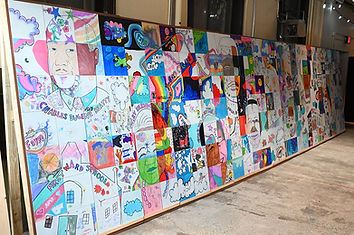
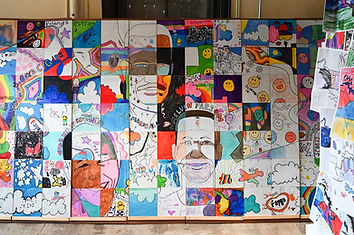
(The fully assembled and student populated mural, as it looked at the Riverside Arts Center)
The mural was first sketched out, then scaled up, and finally cut into 210 pieces. Those included in the mural are (in this order):
Charles Eugene Beatty - Michigan’s first Black male principal, and one of the originators of the Perry Preschool Project
Mary Herndon - Fought against urban renewal and then worked to relocate those displaced, working for the Ypsilanti Housing Commission for many years
Dr. R. Wiley Brownlee - Former Willow Run High School principal who focused on making a safe and inclusive space for all students amidst racial tensions (Dr. Brownlee was tarred and feathered by the KKK during his first year, which only made him work harder)
A.P. Marshall - A librarian and educator who initiated the Ypsilanti African American Oral History Archive
Melvin Parson - A visionary who worked to break the cycle of incarceration by creating opportunities through farming
Victoria Swanson-James - A community activist, educator, and trailblazer for clergy women
Demetrios Ypsilanti - A leader in Greece’s war for independence from Turkey and this city’s namesake
Maude Odum Forbes - A fierce supporter of education, beginning as a teacher at Perry Elementary, then becoming Ypsilati’s first Black female principal at Fletcher School
Reverend S.L. Roberson - A true community leader supporting and influencing many lives, serving as Pastor of Metropolitan Memorial Full Gospel Baptist Church of Ypsilanti for 56 years
Vanzetti Hamilton - A pioneering lawyer who took on civil rights and discrimination cases
Also featured:
First Ward School - The first building constructed with the purpose of serving as a school for Ypsilanti's Black children, as they were not allowed to attend the city's schools
George McCoy's Cigar Wagon - A former Kentucky slave who fled to Canada with his wife, George and Mildred McCoy eventually returned and settled in Ypsilanti and aided other fleeing slaves through a hidden compartment in his cigar wagon
The City of Ypsilanti - The city's boundary is at the center of the mural
Michigan State Normal School - Founded in 1849, this school was designed to educate and train teachers to fill public schools across the state, eventually becoming Eastern Michigan University
Ypsilanti Armory - Built in 1923 as a military storage and training facility, this Southside structure became the venue for many celebrations, fundraisers, concerts, trade shows, weddings, and much more
Brown Chapel AME Church - One of the earliest Black congregations in Michigan, the physical church was in part made possible by Isa Stewart, who fled slavery in Virginia and helped others do the same as part of the Underground Railroad (the church outlined in the mural is not the original structure but how it looks today)
Faygo - There are six Faygo logos in the mural, representing the Faygo distribution center that once existed on Ypsilanti’s Southside at Harriet and Huron Streets
Consolidated B-24 Liberator - There are eight B-24 silhouettes representing the massive production that took place at the Willow Run plant during World War II
Clouds - 35 clouds populate the spaces in between to no student had a blank square
Each link below corresponds to the work created at that school for this project.
